
The other day I outlined the approach I take in designing off-season training programs at this time of year (Early Off-Season Hockey Training). To reiterate, this is the time of year to focus on restoration and re-integration, NOT on “performance”. The other thing that most players need a refresher on is nutrition. It seems that “normal” nutrition habits for hockey players has gotten exponentially more abysmal since I played (and it was bad then!).
I got an email a while back from the mom of a player I used to give on-ice lessons to years ago saying that many of the other parents on her son’s team would stop to get their kids donuts and Red Bulls before games! Yes, Red Bull gives you wings. Unless you’re 10, then Red Bull gives you heart palpitations and anxiety attacks. Nothing says teaching proper eating habits like 100% simple sugar and heavy-dose stimulants. What the hell. Give them a Spike. “You know-I just don’t understand why Attention Deficit Disorder has been on the rise in the last 10 years. What about pumping my children full of sugar and stimulants, letting them play technologically advanced video games, and sufficiently ignoring them so they can spend their remaining time listening to music while playing with their iPhones would impair a young developing adolescent’s ability to focus single-mindedly on one task?”
Idiots.
…deep breath…
Anyway, a few minutes ago I was saying something about nutrition. Most youth players have the intention of putting on weight during the off-season. For some, this will come quite naturally. Once they start training hard, they’ll naturally start eating more and the weight piles on. For others, it can be more difficult. Having dealt with dozens of these players over the last couple years, most claim they “eat all the time” and most…well…don’t eat all the time. As I’ve said in the past, if you have the frame of Gumby, you don’t eat enough. It’s that simple.

I don’t know why I can’t put on weight. I eat ALL the time!
What’s less simple is finding a middle ground to help get these players eating more. Many are picky eaters and have a hard time getting in enough calories because of that. The typical recommendations I’d make to someone curious about how to eat better (and more) don’t work in these cases. Almost without exception, though, these players will suck down smoothies once I give them the recipe. There are infinite variations to this, but the idea is still always the same:
- Find a flavor combination that the player will like (dare I say…look forward to?)
- Mix in healthy ingredients that they can’t taste
- Double, triple, or quadruple the recipe based on how emaciated the players frame is (the more dire the weight gain need, the more calories per smoothie and the more smoothies they should drink)
The Recipe
If you know me personally, you know that I don’t count calories and I don’t measure anything. My morning and post-workout smoothies are thrown together haphazardly based on how hungry and/or distracted I am at the time. My friend Brian St. Pierre, however, is much better about giving more “defined” recipes. This is a smoothie recipe that I’ve never gotten any “guff” about. It seems that Brian developed a universally appreciated smoothie recipe.
Brian’s Chocolate Peanut Butter & Banana Smoothie
- 8 oz unsweetened chocolate almond milk
- 1 scoop chocolate protein
- 1 banana
- 1 tbsp milled flax seeds
- 1 tbsp cacao nibs
- 1 tbsp natural peanut butter
- ice cubes
Nutrition Information: 435 calories, 29 g protein, 18 g fat, 42.5 g carbs, 10 g fiber
This is pretty similar to what my smoothies look like, but I at least double all the ingredients and use whole milk instead of almond milk, and add in what I’d estimate is about 1 cup of frozen mixed berries.
Kevin’s Frankstein Version of Brian’s Chocolate Peanut Butter and Banana Smoothie
- 16 oz organic whole milk
- 2 scoops chocolate protein
- 2 bananas
- 2 tbsp milled flax seeds
- 2 tbsp cacao nibs
- 3 tbsp natural peanut butter
- 1 cup frozen mixed berries
Nutrition Information: >1200 calories, >60 g protein, >36 g fat, > 90 g carbs, > 20 g fiber
Obviously all nutrition facts are just very loose estimations, BUT the point is that most hockey players fail to put on sufficient weight in the off-season because they can’t stomach eating as much food as they need to. If you take my smoothie recipe from above and drink two of them per day on training days and 1 per day on non-training days, on top of eating all the other foods you normally would, that’s another 1,200-2,500 calories per day, packed full of other quality nutrients. so if you want to look less like Gumby and more like this guy, start taking down smoothies for breakfast and after your training sessions.
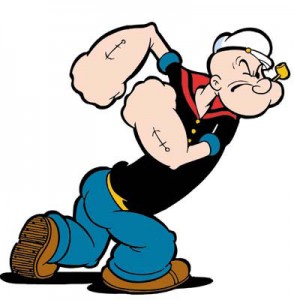
Good acceleration angle
To your success,
Kevin Neeld
P.S. Tonight is your last chance to save $70 on my Premier Hockey Training Program!
Please enter y
Kevin Neeld
post comments
Together We Rise: A Campaign for Everyone