
Speed is one of the most coveted qualities in every sport, but especially hockey. As a result, it’s the most common training goal I hear from athletes, parents, and coaches, both at Endeavor and when I get questions through email.

A couple weeks ago I had a dad drive his 13 year old son down to Endeavor for an assessment. It was great working with the kid because, despite being so young, he was really interested in improving and dialed into the importance of not just training, but training properly.

Endeavor Banner

The main reason they decided to make the trip is because the player was a step slow for the level he was at. Again, this is something I hear A LOT, so I think providing some of the more common limitations to speed in these situations is helpful.

After going through our assessment process, we discovered:

  1. He was a giant for his age (around 5’6″ and 157)
  2. He had a 1/2″ of ankle dorsiflexion on his left side, -1/2″ on his right
  3. His single-leg stability was poor, not allowing him to perform a 1-leg SLDL (unloaded) or split squat with proper alignment
  4.   He did one chin-up, but couldn’t do one push-up with proper torso control (e.g. not letting the lower back overarch and hips sag on the way up)

In summary, we have a player that was far above average in terms of his size, had exceptionally limited ankle dorsiflexion, poor single-leg stability, and generally wasn’t strong.

Growth Spurts Compromise Coordination

To break things down a little more, it’s extremely common for kids that go through growth spurts to have coordination issues. It’d be like you standing on stilts and trying to go through your normal daily behavior. It takes the nervous system some time to repattern around new levers and a higher center of support.
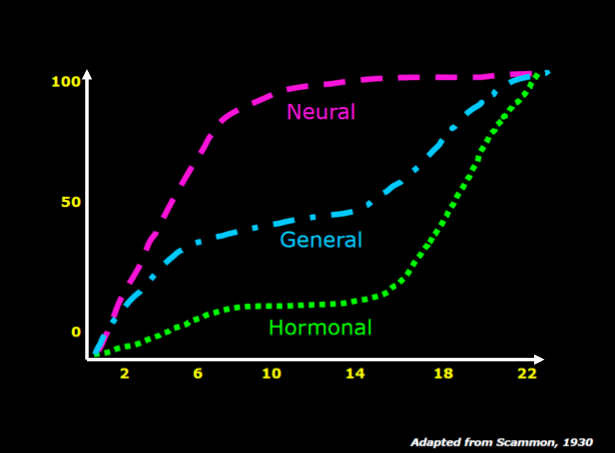
Hockey Development-Physiological Factors

There is considerable variation at the timing of the development of different systems in the body

Ankle Mobility Matters

The standard for ankle dorsiflexion range of motion in the test we use is 4″ bilaterally. He had 1/2″ on one side and negative motion on the other.

Not having ankle mobility is a big deal.

It will prevent him from being able to get into a good acceleration position as he won’t be able to position his knees appropriately in front of his foot to get a strong push back. It will also cause his foot to collapse in anytime he tries to get into these positions that he doesn’t have the range for.
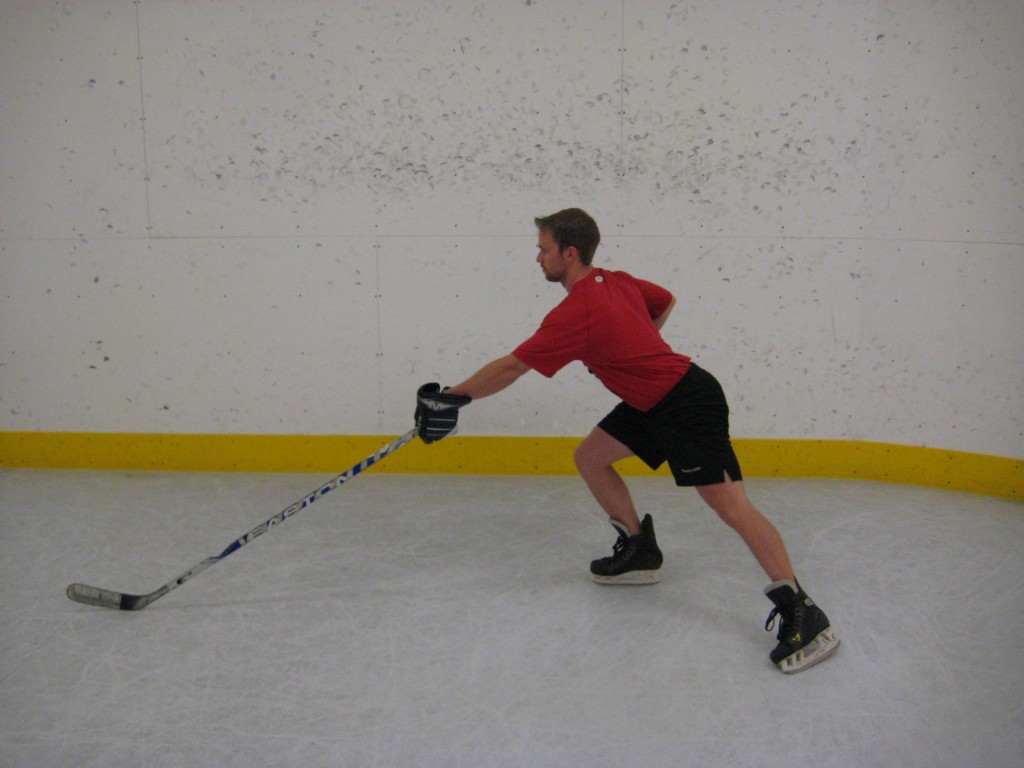
Optimal Skating Stance

Despite being in a skate boot, the ankle needs to move well to get into good skating positions.

When the foot collapses in, the knee tends to collapse in with it. This not only leads to compromised stability on the stance leg while skating, but it also causes players to ride their inside edge more, effectively increasing the friction between their skate blade and the ice, slowing them down a little on each stride.

Lastly, ankle dorsiflexion is tied to hip extension so limitations in ankle mobility are likely to be mirrored by limitations in hip mobility. An easy way to understand this concept is to think of your ankle and hip position as you’re walking. When you transfer your weight over your foot, your ankle needs to go through dorsiflexion (shin transfers forward over your foot) as your hip extends. A lack of dorsiflexion will cause your heel to peel up early, which prevents the hip from going through extension. Given how important hip range of motion is to the skating stride, it’s essential that we don’t neglect some of these secondary drivers of hip mobility limitations.

Strength Is the Foundation For Speed

It’s extremely rare that I see athletes that have above average strength and reasonable body composition and are still slow. There’s a reason for this. Movement is driven by ground reaction forces.  In this case, the force a player is above to drive through the ice is what propels them forward. If you can’t produce a lot of force, you can’t produce it quickly…meaning you can’t be fast.

Limitations to Improved Speed

Anytime someone comes to train with me, I try to think of their training goal in terms of what is limiting them from achieving that goal, and then what do I have the best ability to influence. For example, a player that comes to me with the same goal, but is mobile, stable, powerful, and strong may be best served by seeking out a skating coach. A player that has all the tools, but suffers from consistency issues may need help outside of training or on-ice settings (e.g. with diet or sleep behaviors).

In this case, the player has very notable (and common) limitations in areas that will directly impair his speed. If he can clean up his ankle mobility, get on a quality full body strength training program, and work on his single-leg stabilization strategies, he’ll be able to get into better skating positions on the ice, apply more force into the ice with each stride, and maintain a more stable stance leg to decrease the friction with the ice and get more out of each push from the stride leg.

Understandably, most players think they need to do more sprints if they want to get faster. This strategy works, but only to a small extent. In this case, the player would basically be maxing out his speed potential with limited ankle mobility, compromised single-leg stability, and poor force producing ability. In contrast, if he addresses these limitations first, he’ll not only be faster, he’ll have more room for improvement moving forward.

Wrap Up

Wrapped in all of this discussion is an underlying message to parents of youth players that you need to be patient. Puberty is a wild ride, and having worked with players at a variety of ages across many years, I can say, confidently, that the kids that excel early aren’t always the ones that are still ahead of the pack a few years later. Be patient and continue to emphasize good practice/training habits and having fun!

To your success,

Kevin Neeld
HockeyTransformation.com
OptimizingMovement.com
UltimateHockeyTraining.com

P.S. If you’re interested in off-ice speed training exercises for hockey players, check out Breakaway Hockey Speed, which now comes with a full downloadable exercise database!

Enter your first name and email below to get your FREE copy of 5 Strategies to Improve First Step Quickness

Get Ultimate Hockey Transformation Now!

Year-round age-specific hockey training programs complete with a comprehensive instructional video database!

Ultimate Hockey Transformation Pro Package-small

Get access to your game-changing program now >> Ultimate Hockey Transformation

“Kevin Neeld is one of the top 5-6 strength and conditioning coaches in the ice hockey world.”
– Mike Boyle, Head S&C Coach, US Women’s Olympic Team

“…if you want to be the best, Kevin is the one you have to train with”
– Brijesh Patel, Head S&C Coach, Quinnipiac University

post comments

  1. Craig October 13, 2014 at 9:29 am - Reply

    Hi Kevin,
    Like the article. My son has had a similar experience, but opposite of what you describe. He is a very late bloomer. He is late on all three growth phases, neural, general and especially hormonal. It runs in my wife’s family so it is no surprise. He just turned 14 in May and is starting to grow.

    He has been working out at a gym that has a good hockey based workout program. The owner does off-ice hockey training with one of the local colleges and several high schools. So he has worked on his strength somewhat. He is also an excellent skater and has been complimented by every team and hockey school coach he has ever had, but has slow straight ahead speed. To give you an example, my son did a 3 cone weive drill and then raced to a puck. My son beat a much larger and faster player to the puck because he is good on his edges. Then when they raced in a straight line drill (goal line to blueline) he lost by about 3-4 strides maybe more.

    When he was 8 or 9 he was one of the faster kids (end of speed 1) now he is average at best. How does late puberty affect a kids speed? Obviously size can make a huge difference, but does a late hormonal growth affect speed more than size? He has never been a real big kid, but was relatively fast at the end of speed 1.

    Thanks

    Craig

  2. Mark Holleman October 13, 2014 at 9:47 am - Reply

    Kevin,

    another great read! I have already purchased one of you publications a few years ago and it had a plenty of great information for a dad that never played.

    What you talked about today is spot on with what’s holding my son back but how does someone in Grand Rapids Mi find a training facility that gets the mobility issue? My son is 13yrs old, average build, and large hip bones (great form/stride but just doesn’t look like he is opening up the hips when he skates and consequently is slower)
    any suggestions besides shipping him UPS to Endeavors!

  3. Scott Umberger October 13, 2014 at 9:57 am - Reply

    Great write up. I usually get ” coach/skating coach said that they need to get their core strong” which has become funny at this point.

    How are you evaluating dorsi/planar flexion?

  4. Kevin Neeld October 13, 2014 at 10:06 am - Reply

    Craig-This may not be what you want to hear, but the short answer is to just be patient. Speed at a young age is rarely an indication of speed at an older age. Anyone that’s spent time around hockey has seen plenty of kids go from the fastest on their team in squirts/peewees to middle of the pack by midgets. The opposite is also true (from slow to fast). It’s awesome that he’s become such a great skater; this is very common in kids that aren’t blessed with lightning speed at young ages because they’re forced to work on the other parts of their game. It’s a positive. I wouldn’t worry about the late hormonal push; it will help his strength and speed tremendously, especially if he’s training properly.

  5. Kevin Neeld October 13, 2014 at 10:09 am - Reply

    Mark-I would ask for referrals, contact Functional Movement Systems (http://www.functionalmovement.com/) and see if anyone around you has taken a course, and do some homework on effective ankle mobility exercises online. We have had kids from Michigan make the trip out to Endeavor though, so that’s always an option!

  6. Kevin Neeld October 13, 2014 at 10:13 am - Reply

    Scott-Yes, and everyone over 6’2″ needs to work on getting their feet quicker. I don’t want to dismiss qualitative assessment, but that type of feedback is just short of worthless without some what to quantify where the player is actually at. Sometimes guys need to watch more film, not do more plyometrics (as you know).

    We use the FMS board to quantify ankle dorsiflexion in inches. Big thing is to make sure the foot doesn’t pronate as you assess. We’ll line the foot up on the board with big toe at 1″ with the outside of the foot lined up along the outside of the board. I hold a pole at the 1″ mark just off the edge of the board and have them shift their knee forward toward that, and progressively move it as they show me they can get it.

    We don’t quantify plantarflexion, but we’ll mix in a few mobility exercises that pull them into plantar flexion if they feel an anterior restriction during dorsiflexion work or if they aren’t making progress doing our other mobility exercises. We basically just do it to gap the talus. Hope this makes sense.

  7. Chris Phillips ATC, CSCS October 13, 2014 at 10:31 am - Reply

    Kevin,

    Great article. I recently had a quarterback who had no dorsiflexion. He was working an “elite trainer” who kept putting a 2×4 under his heels for squats and no one knew why he didn’t get any stronger or faster. We noticed the lack of ankle mobility, made changes and now he is making great strides in both areas.

    Thanks

  8. Scott Umberger October 13, 2014 at 12:50 pm - Reply

    Amen… I figured that you would be using that test. I wanted to confirm.

    Is it me or are you seeing a ton of athletes with “flat feet”? I don’t know if I’m getting smarter and able to recognize it or it’s our current sports system and foot wear that’s producing these feet. Any thoughts?

  9. Andrew October 15, 2014 at 2:24 pm - Reply

    This is like hippocampus and plastic brain for good luck and for other thinking paradigm about moving technologies…

  10. Michael Thede October 15, 2014 at 3:38 pm - Reply

    My son is working with local Pilates instructor who us doing wonders for increasing flexibility, this is one way to get help to your player where hockey specific fitness trainers are not located in your geographic area.

  11. Kevin Neeld October 16, 2014 at 2:27 pm - Reply

    Chris-I still don’t understand why people do that. If he doesn’t have the mobility to squat, just don’t squat! Seems pretty simple. Glad he found his way to you.

  12. Kevin Neeld October 16, 2014 at 2:32 pm - Reply

    Scott-I think you’re seeing more flat feet because you’re getting smarter and because of an increased prevalence. Most of the shoes our kids walk into our facility with definitely aren’t helping their cause. We have a lot of kids take them off because it completely ruins their stabilization strategy. We’re not the only ones noticing it. I’ve had 3 separate companies contact me recently about new performance orthotics or foot/ankle training devices.

  13. Kevin Neeld October 16, 2014 at 2:33 pm - Reply

    Michael-Exposure to different training methods is a good thing. That said, I always feel it’s important to point out that more flexibility isn’t always better. Most great coaches understand this, but we still see kids that, for example, have drastically overstretched their hamstrings and adductors and it’s hurt them later down the road.