
Last week I posted two discussions on the status of youth hockey development that pointed out some commonly held misconceptions, areas that need revamping (or at least have room for improvement) and some of the barriers that the hockey community will face in pursuing a more effective model. If you missed those posts, I highly encourage you to go back and read them before continuing on here today. Check out the links below:
Hockey Development Post 1 –>> The State of Youth Hockey
Hockey Development Post 2 –>> Hockey Development Resistance
Those discussions were primarily inspired by my experiences in learning more about USA Hockey’s American Development Model. If you haven’t yet, I recommend heading over to their site and reading more about it: ADM Kids
Somewhat to my surprise (I thought I’d get more hate mail), both posts were really well received and a few people responded with great comments. One in particular had to do with the apparent discrepancy between the recommendation that youth players participate in multiple sports and activities in order to achieve elite level status later down the road, and the idea that players need to spend a substantial amount of time developing their sport-specific skills in order to perfect their abilities. This latter idea is referred to as the 10,000 hour rule, as some research has shown that it generally takes about 10 years and 10,000 hours of purposeful practice for an individual in ANY field to achieve expert mastery.
It’s easy to interpret the 10,000 hour rule as meaning that hockey players should focus ALL of their athletic time on the game of hockey to accumulate as many “practice hours” as possible at younger ages. Unfortunately, this idea is often misunderstood because “practice” is never adequately defined, and the idea of progressions and age-/developmental stage specificity is often lost. Briefly, I think it’s important to note that taking a young kid and submerging them into a single activity with the intention of making them one of the world’s elite has TREMENDOUSLY negative physical and psychological consequences. For our purposes today, however, I want to focus on what constitutes practice within the 10,000 hour rule paradigm.
In order to understand what counts as practice, we need to have an understanding of what drives performance. At a minimum, it’s important to understand that there are physical and psychological components. The lists below are slight expansions on these ideas.
Physical Components of Performance
- Technical Skill
- Athletic Ability
- Durability
Psychological Components of Performance
- Hockey Sense
- Mental Preparation
- Grit
Again, these lists are far from exhaustive, but are meant to start directing your thoughts as to lesser recognized components of performance and therefore of lesser recognized necessities of practice. So for a young hockey player looking to accumulate as much practice time as possible, what should they do?
10,000 Hours of Hockey Practice
- Structured hockey practice
- Unstructured hockey (pick-up)
- Watching game film of personal performances
- Watching practices, games, and/or film of players at the next level up
- Playing other sports
- Off-ice training
This is a pretty short list, but can be branched out to a wide variety of activities. Structured practice will help players develop technical skills, hockey sense and, at the appropriate age, their tactical awareness. It’s important to recognize that having 100 hours of practice won’t lead to 100 hours of benefit if the players spend the majority of their time standing in lines or staring at the ceiling while the coach draws on the whiteboard. This is one of the strongest points of USA Hockey’s recommendations for players at younger levels and one of the primary benefits of unstructured play-the kids actually get to touch a puck and move around on the ice! Unstructured play will also help develop technical skills and hockey sense, but increases the emphasis on fun (this doesn’t mean not COMPETING, it just means that the competition is for pride instead of the mixed emotions of pride, not letting your coach down, and not getting “Vince Lombardied” by your parents on the ride home from the rink), and ultimately fuels a kid’s passion for the game. Watching game film and next-level hockey will help players develop hockey sense, tactical skills, and components of technical abilities secondary to visualization. In other words, hockey players can improve their performance simply by analytically WATCHING players at the level above theirs.
Playing other sports and off-ice training serve some common and quite supplementary purposes. First, playing other sports exposes kids to different coaching methods, different social groups, different physical stresses, and emphasizes different athletic components. This helps develop highly coachable athletes with lots of friends, that are further from injury threshold and have more advanced athletic capacity. Simply, there is NO wrong here. To provide an athletic ability example (because that’s all the crazy parents and coaches will care about), playing baseball is “hockey-specific training” at younger ages. It teaches rotational power, hand-eye coordination, first step quickness, rapid reaction, and athletic body positions, all things that transfer. Similar arguments could be made for the benefits of soccer, lacrosse, basketball, football, and tennis for hockey. These other sports also provide more opportunities for young athletes to experience success, which is a primary driver in confidence. Also, simply because the “hockey player” is NOT playing hockey, they are maintaining a safe distance from their injury threshold due to overuse/under recovery (e.g. my stress overflow “theory”). Playing competitive hockey year-round is making old men out of young players; the insane number of players we see with chronic hip flexor and adductor (groin) injuries is evidence of a flawed development system. These nagging injuries become career limiting/ending for some, and experience/potential fulfillment limiting in everyone. Referring back to the lists above, it COMPROMISES durability.
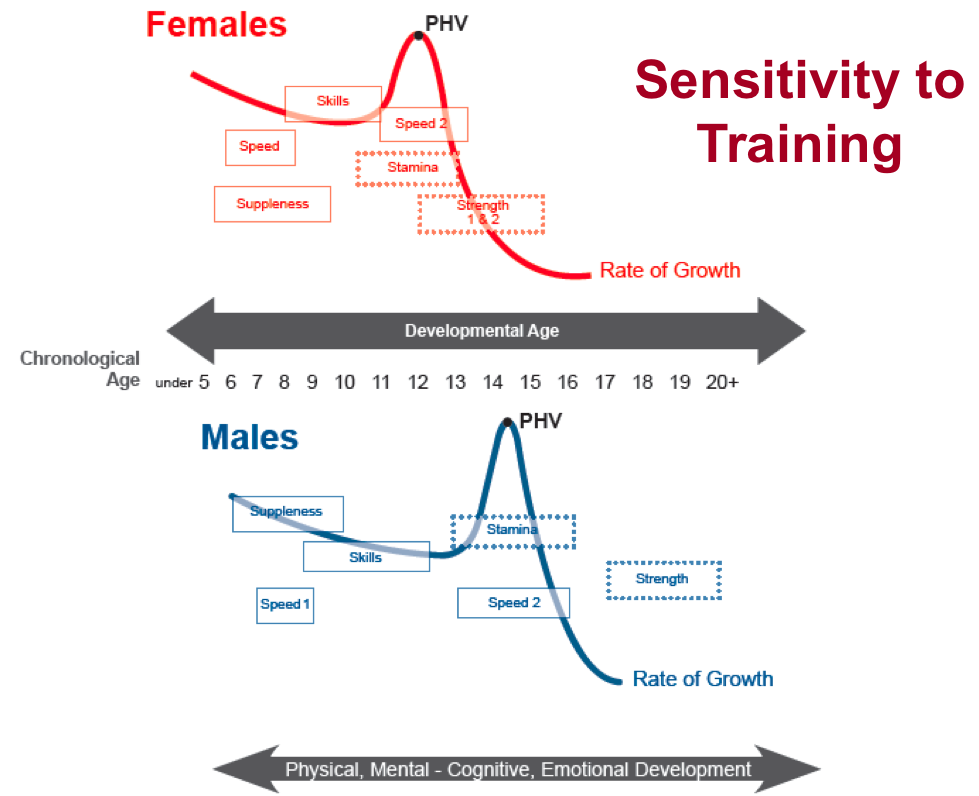
Regarding off-ice training, even BASIC off-ice activities like skipping, hopping, holding single-leg stance, etc. will help improve coordination, rythmicity, balance, and other motor qualities that will positively influence hockey. The nature of the off-ice training should develop in accordance with the physical quality sensitive periods.
Take Home Message
The 10,000 hour rule holds merit in long-term hockey development. If the goal is to achieve elite level status, it’s going to take time and hard work. Throughout this process, it’s important to broaden our horizons on what is considered practice and not ignore age-specific recommendations. 1,000 hours of practice for a 10-year old should NOT look like 1,000 hours of practice for a 20-year old. Seeking to build advanced hockey-specific skill sets on a narrow foundation of proper movement is a recipe for disaster. They call it long-term player development for a reason. Follow age-appropriate recommendations and be patient; excellence is inevitable.
To your success,
Kevin Neeld
P.S. I have a really special announcement later this week so make sure you check back!
P.S.2. If you think other players, parents, coaches, friends, family members, or co-workers would benefit from this information, please pass it along!
Please enter your first name and email below to sign up for my FREE Athletic Development and Hockey Training Newsletter!
post comments
Together We Rise: A Campaign for Everyone




Just came back from watching a HS game. Noticed a kid who could really skate, but could not handle the puck at all. He had his left hand basically in his stomach, and his right hand all the way out to the side. It affected his balance, made him very predictable, and he was unable to protect the puck. What if has been doing this for the last 10,000 hours ?
Getting education to parents/coaches about the multi-lateral adaptation approach to athletic development has been a stuggle for me. I am asst. coach at the Squirt AA level and parents feel that they must steam roll their child into year round hockey. I try to stress to them the psychological and physical needs a child must meet in order to become a better athlete, not just a hockey player. I feel it is a myriad of U.S. cultural deficiencies that keep parents from taking a step back and letting their child figure it out themselves and not be placed into hyperdrive the moment they get on the ice.
DM-I feel your pain. You coach at the level where the craziness really starts to set in and I agree with your assessment of U.S. culture. Although, this is not strictly a U.S. problem. Interestingly, whereas there are certainly physical and psychological justifications for the “more unstructured play” and “play multiple sports” recommendations, USA Hockey (and ALL of the supporting research) isn’t suggesting that this is the better approach to create healthier, more well-rounded people (which is true). They’re saying that it’s the best approach to create WORLD-CLASS hockey players! In other words, if a parent is thinking “I don’t care if my son/daughter becomes a better athlete; I just want them to be the best HOCKEY PLAYER out there” they would STILL be wrong in placing them in a structured year-round hockey environment. At young ages (e.g. < ~14 y/o), the key to developing physically and psychologically healthy, well-rounded athletes and members of society is the SAME as developing world-class hockey players! This is often the disconnect in the intention and perception of the message. Keep fighting the battle though; our kids are worth it!
Pops-Your point is well-taken. 10,000 hours of purposeful and progressive practice is the key. Doing wrong for 10,000 hours will only result in deeply engrained wrong.
[…] Hockey Development Post 3 –>> The Truth About Practice: The 10,000 Hour Rule […]
Hi Kevin,
I have followed your website for awhile now and enjoy your materials. You recently wrote about the 10,000 hour idea to reach peak expertise and I thought I would comment on it.
I’m a sports psychology consultant here in Orange County, California and I focus my practice on ice hockey players for the most part. I do speak to many athletes and more so to their parents, on what it takes to become an “expert” as an athlete or in a profession. This can apply to being a musician, athlete or financier to name a few.
The cornerstone to becoming an expert is what is called “deliberate practice”, or some call it “purposeful practice” and much research-based literature has been written on this topic. A though leader in the field is an academic by the name of Anders Ericsson working out of Florida. One book he wrote was with a colleague of his by the name of Janet Starkes. The book is called “Expertise Performance in Sports: Advances in Research in Sport Expertise”. This book is very helpful if you are trying to gain deep insight into building expertise in sport.
Getting back to the idea of the deliberate practice framework, it states that expertise is acquired over extended periods of time with intense training and preparation. Many articles have been written that widely advocate the 10,000 hour or 10 year guide as the timeline to become an expert in a given specialty of a profession such as a NHL hockey player.
Research also claims that an athlete needs to practice every day for no more than two hours. Best results are achieved when deliberate practice lasts for just over an hour. This is where rest and recovery comes into play.
Another interesting finding regarding practice was done with navy fighter pilots. They found that if you stopped practicing, that in only two weeks, almost 10% of their skills were diminished when performing a difficult task such as landing on an aircraft carrier.
Let’s do some arithmetic on the 10,000 hour rule for developing expertise. I recently read a study on NHL hockey players that determined a player’s performance is at their best around the age of 26 years. So, if we consider the deliberate practice fundamentals, a young developing hockey player would work out let’s say an hour a day, seven days a week, and throw in a game that adds 3 hours more per week, then the athlete is putting in a total of 10 hours a week of development time. Now let’s assume the hockey player trains for 52 weeks a year, then the total training time put in per year is around 520 hours. With this information, let’s divide 10,000 hours by the 520 hours of practice per year and we find that it will take just a little over 19 years to reach your best and likely you will be performing at an expert level if you practice and train correctly. So the math tells us that a young athlete should begin learning to play the game at around the age of seven.
So what does this tell us?
First, don’t rush an athlete’s development, it clearly is the process of “what to be doing to get where you’re going”. Second, find the best coach you can afford and learn everything you possibly can from that teacher/coach. Finally, I believe the most important human characteristic in becoming an expert is persistence! You must believe in yourself and stick to the training over many years and you will get there, or at the very least you will have become the best you can be. Good Luck!
I hope this adds some more insight around this discussion.
Dr. Petersen-Thanks for the kind words and for offering your expertise. What are your thoughts for the parent or player that responds with “If it takes 19 years at doing 10 hours per week then it should only take 10 years at 20 hours per week!”? Maybe they rationalize that decision in light of your “Best results are achieved when deliberate practice lasts for just over an hour”comment by having training/practicing for two single-hour blocks separated by a few hours each day.
As a Pee Wee coach I struggle with trying to make on-ice practices “purposeful” for a variety of different skill levels. Any suggestions/examples how to accomplish this?
[…] The Truth About Practice: The 10,000 Hour Rule […]
Kevin,
Clearly parents and coaches are doubling up on practice time to reduce the 19 year time frame. This is evidenced by kids going pro at 18 years of age, but this is very rare when you count the number of kids playing the game. Many factors come into play that argues for the coach to take time to develop the player; such as the body not fully grown out into your early 20’s, intellectually the mind isn’t developed, which affects pattern recognition ability, that is one key capability related to being a good hockey player and finally motivation, which is a huge factor to want to continue to train hard over long periods of time. But again there are exceptions to this evidence. Players, parents and coaches simply need to understand that it takes time to reach this lofty goal.
To RJ:
Breaking a skill down, called decompostion, into several different parts and creating purposeful practice activities is difficult. It takes thought and personal practice to get good at it.
Let’s use the example of teaching peewee level kids to shoot a snap shot at a net. Think about having 3 different skill development stations. The beginner station is at the blue line, where the player needs to see the net (target), apply the proper technique to take the snap shot and the goal is to hit the net. The next level up would be to have a station at the centre of the defensive circle. The players now do a snap shot with the intention to hit the left, right or five hole (directional shooting). Finally, your third station is the most difficult, where you have the player at the top of the goalie crease. Here the player’s intention is to take a quick snap shot and the goal is to hit the top left or right corners of the net (elevation shooting).
What you clearly have here is a progression of skills that a player can use to develop their skill(s) to this particular type of shot. Many good hockey books provide a variety of different drills, so if you do some reading you can develop your own matix of skills and levels of drills to support your practices. John Wooden of UCLA spent endless hours building drills that supported his team’s development and we all know of the results he got.
Good Luck!
[…] with each other and coaching staff. We have alot of new kids and it was our first game with limited practice so we need to build from […]