
Should you foam roll your IT band? This is a question that has perplexingly persisted at the forefront of arguments within the rehabilitation and fitness fields for several years.
The topic took social media, annoyingly, by storm last week, as everyone linked to a recent post from Dr. Andrew Franklyn-Miller: Ilio-Tibial Band: Please do not use a foam roller
To provide a quick backdrop, the iliotibial band (or IT Band) is a thickening in the fascia on the outside of your thigh. If fascia is an unfamiliar term, just think of the thin clear film that’s wrapped around your chicken breasts.
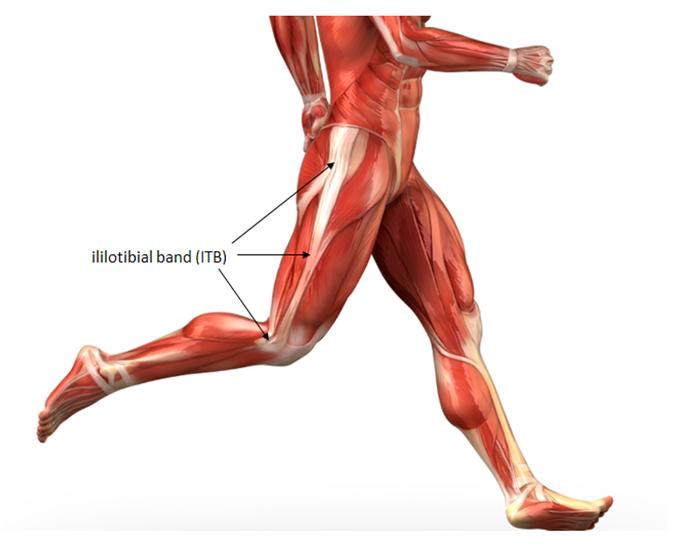
That white band is actually just a thickening of a tissue that encompasses the entire thigh and spreads continuously above and below throughout the entire body. (Image from athletico.com)
Fascia, like all structures within the human body, responds to stress. In an effort to provide improved lateral stability to help accommodate the loads of single-leg stance, the fascia lata (which surrounds the entire thigh), is thicker on the outside. This thickened band of tissue has been cut out with a scalpel in cadavers and given its own name (i.e. the IT Band), leading to a number of misunderstandings common to isolationist approaches to anatomy.
The IT band has direct connections to the gluteus maximus and the TFL (tensor fascia latae; one of your hip flexors), and extends down to blend with structures on the lateral knee.
Because it’s common for people to have lateral knee discomfort, the IT band often gets blamed as the culprit, leading to recommendations to smash the IT band with a foam roller, and then stretch it.
Clearly, this is a misguided approach. There is sufficient evidence to suggest that the IT band doesn’t elongate appreciably (which Dr. Franklyn-Miller cites in his article), meaning you can’t really stretch it.
Further, blaming a thickened part of fascia for lateral knee pain without consideration to factors like ankle mobility, tibiofemoral rotation, hip range of motion, hip control, capacity of the muscles controlling the hip, leg, and foot, total volume of work placed on the system, among others, is about as sensible as Billy Madison’s take on Reflections of Society in Literature.
Of course, leave it to the internet to perpetuate a wide-spread over-reaction. This is a classic case of throwing the baby out with the bathwater.

Just because the IT Band doesn’t elongate appreciably and likely has very little, if anything, to do with lateral knee pain, doesn’t mean using a foam roller on the lateral thigh doesn’t have value.
It’s interesting to me that so many people would ignore positive feedback from people that have foam rolled the area and have felt better both immediately afterwards, and over the long term. I imagine the conversation goes something like this:
Self-Proclaimed PubMed Expert (SPPME): “I know I told you to roll that area last week, but now you shouldn’t.”
Human: “But I actually feel a lot better after I do it.”
SPPME: “Yes, but last week I read an article on Facebook that says it doesn’t do anything.”
Human: “But I feel better after I do it.’
SPPME: “You’re not getting it. The article cited several studies that took a dead person’s leg through common orthopedic tests and it CLEARLY showed that the IT Band didn’t stretch.”
Human: “Did the cadaver foam roll?”
SPPME: “Of course not. Dead people can’t foam roll.”
Human: “Then I guess they couldn’t report feeling better afterward either. I’m outta here.”
Not so subtly hiding underneath the IT Band is the vastus lateralis, the biggest of your four quadriceps muscles. This muscle wraps around ~50% of your femur, from the middle of the front part all the way around to the middle of the back of your femur.
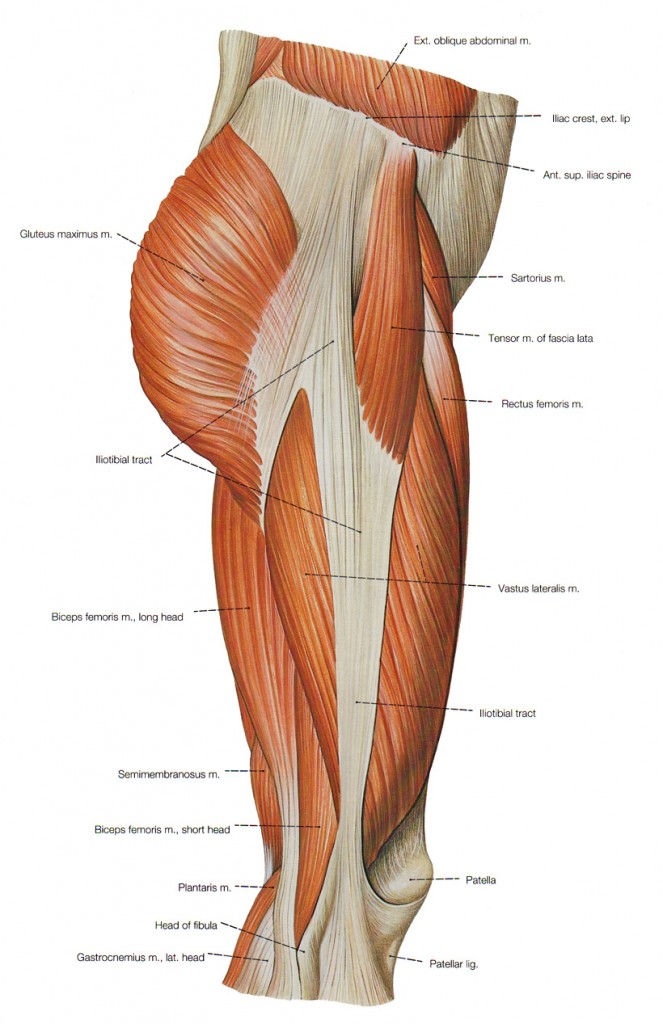
Image from http://www.corpshumain.ca
It, like every other muscle in your body, still has blood flow. It still has neural inputs and sensory receptors providing feedback about the resting tension in the muscle. It can still develop trigger points.
Foam rollers and other rolling implements, can generally be used to accomplish three things:
- Facilitate circulation by rhythmically compressing the tissue, similar to “effleurage”, a common technique used in Swedish massage
- Provide feedback to the nervous system about areas that may be harboring unnecessary tension
- Attempt to address trigger points using pointed compression, similar to ischemic release techniques used commonly by manual therapists
ALL of these things can still be accomplished by rolling your lateral thigh. You can still roll this area, just don’t call it your IT band.
Even better, instead of plowing directly over your IT band, try rolling directly in front of it and directly behind it. This will allow you to more directly address your vastus lateralis, which is ultimately what you’re targeting when you roll the outside of your thigh anyway.
To your success,
Kevin Neeld
HockeyTransformation.com
OptimizingMovement.com
UltimateHockeyTraining.com
Please enter your first name and email below to sign up for my FREE Athletic Development and Hockey Training Newsletter!
Get Ultimate Hockey Transformation Now!
Year-round age-specific hockey training programs complete with a comprehensive instructional video database!

Get access to your game-changing program now >> Ultimate Hockey Transformation
“Kevin Neeld is one of the top 5-6 strength and conditioning coaches in the ice hockey world.”
– Mike Boyle, Head S&C Coach, US Women’s Olympic Team
“…if you want to be the best, Kevin is the one you have to train with”
– Brijesh Patel, Head S&C Coach, Quinnipiac University
post comments
Together We Rise: A Campaign for Everyone