
Over the last few years, I’ve written and talked quite a bit about preventing hip injuries in hockey players. Unfortunately, things like adductor and hip flexor strains have become accepted as “part of the game”, and now we’re seeing a surge of femoroacetabular impingement, labral tear, and sports hernia cases. The underlying mechanisms to many of these injuries can be pretty complex, but once you get it, many of these cases can be prevented.
A few months back, I posted a video on how to assess for a pretty common structural “abnormality” that we see in hockey players known as “version”. More specifically, players can have unilateral or bilateral ante- or retro-version. If you missed the video, take a few minutes to watch it below:
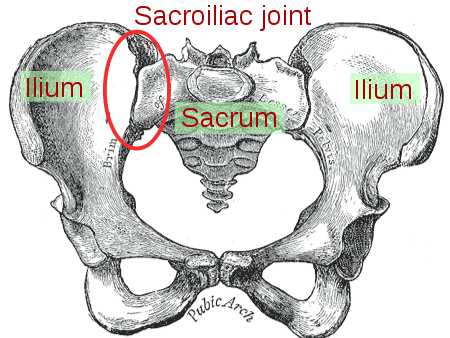
These three connection points (SI joint on each side and pubic symphysis in the front) form a continuous loop. Because of their integration, one segment become misaligned will necessarily result in a misalignment at another segment. For example, an SI joint being out of whack can lead to a shift in the other SI joint and/or the pubic symphysis. Alignment can be compromised from contact, and/or instability secondary to poor or asymmetrical movement patterns, postures, and strength. Misalignments can refer pain to a number of places throughout the thigh, hips, and lower back, but a common one that we see relates to pubic symphysis irritation. When there is excessive movement across the pubic symphysis, the cartilaginous disc that helps improve the contact area of the two adjoining bones becomes inflamed. This is referred to as osteitis pubis and is one of the most overlooked sources of groin pain. These cases are frequently treated with injections to reduce the inflammation, which is effective in putting a band-aid over the pain, but completely overlooks the cause.
In these cases, asking the athlete to squeeze something between their legs while lying with their knees bent will reproduce the pain radiating from their groin up into their hip AND strength will be poor. Many times, a simple “SI readjustment” from a physical therapist or chiropractor will restore alignment and the pain will be gone and strength restored, instantly. At this point, the athlete has a more neutral alignment, but has demonstrated that they’re prone to slipping back into misalignment (and pain, and weakness). Following readjustment, it’s important to incorporate strengthening exercises that put multi-directional bilateral stress across the hips. These exercises serve to improve the integrity of the hip in a neutral position, which will help ensure that they player doesn’t fall in and out of alignment and progressive degenerate the joint. The exercises in the video below were a few that we’ve used at Endeavor in cooperation with Ned Lenny, a really bright physical therapist in Cherry Hill, NJ. Enjoy.
Kevin Neeld
P.S. I’ve added an “ebook only” option to Ultimate Hockey Training, so if you don’t want to shell out for shipping a physical copy, you can now get instant access to the entire package digitally here: Ultimate Hockey Training
Please enter your first name and email below to sign up for my FREE Athletic Development and Hockey Training Newsletter!
post comments
Together We Rise: A Campaign for Everyone




Hi Kevin,
Love your work and this stuff on hips has definitely improved my understanding but I think you might want to consider your thoughts on ‘SIJ missalignment.’ It reads as though you are describing a bony ‘missalignment.’ which can be adjusted.
It has been conclusively proven that SIJ alignment does not change following an adjustment. See http://www.ncbi.nlm.nih.gov/pubmed/9615363
It is the effect on the soft tissue that changes post manipulation not the bony joint positions. We should therfore consider the role of muscular stability across the SIJ. Hope this helps… I have a PDF of this article and loads more if you want.
I have more opinions on this but will hold my breath unless you’re interested.
Yourse in good health
Adam Richmond
Adam-Thanks for the note and the reference. I’m aware that there’s a school of thought that the SI joint doesn’t move and is essentially a locked joint. My understanding is that Vleeming’s research, using better (read: more sensitive) observational methods than were used historically, was able to provide sufficient evidence that it does. I believe Diane Lee’s book “The Pelvic Girdle” also touches on the subject quite a bit. The Postural Restoration Institute also provides more anecdotal evidence of SI joint realignment following certain techniques. It may be a semantic-driven misunderstanding, but I am extremely confident that a more neutral position of the joint can be restored using both manual and non-manual techniques.
That said, I’d be interested in reading some of the better papers on the topic that you may have and hearing your thoughts as well. I don’t put much stock in abstracts (unfortunately many researchers flat-out lie in these), but reading through the papers and getting a better understanding of your perspective will surely be beneficial for my understanding on the topic.
All the best,
Kevin
Hey Kevin. Thanks for the great post. I too train hockey players that present with similar issues as listed above. Weak adductors are all too common with this sport. Hopefully more trainers will read this post and do some prehabilitation work on their clients.
Hey Kevin,
I understand the use of the medball between the knees, and the mini-band around the knees to recruit more of the hip stabilizer muscles (glute-med/min, adductors…). But what is the idea behind the foam roller? To create dynamic stability through the hamstrings on top of the glute max/ adductor magnus?
Do you find it would be easy to ‘cheat’ this and use the quads to raise the hips?
Rich
Rich-That’s exactly the rationale for the foam roller. As with all glute bridge variations, there are ways to cheat to not get the desired effect. In my experience, if the person is set up right (ankles in front of their knees) the roller makes it extremely unlikely that they’ll substitute quad-driven hip extension. That said, why not give it a try before forming an opinion one way or another? Hope you’re well.
Kevin
Kevin,
What is the length of the powerband you use in the video? Keep up the great work! I always look forward to your emails.
Best,
Scott
I agree with what you said because my massage therapist realigns my hip/pubic symphysis and my os pubis pain goes away. However if I stretch a lot it falls out of place. I need to do those glute exercises when hip are aligned however my hip have a anterior tilt (arse sticks out) and everytime I stretch to help that it falls out of place. Usually when I stretch quads it happens. How do I achieve both
Josh-You may just be stretching too aggressively. Tough to troubleshoot these issues over the internet, but if you focus on keeping some tension through your core as you do your hip stretches it should help provide some extra stability to your hips as you try to lengthen whatever muscle you’re stretching.
Hi Kevin,
I have been diagnosed with OP after thinking I had just strained my groin. I played a season of field hockey with SI pain in my right side. It was annoying but still bearable and I could get through games.
This season however I have only played once and my right groin is a mess. I have tried all sorts of glut med exercises but I have only made limited progress. Your video explains my symptoms exactly.
If I do a bridge I get a grinding feeling where my pubic bone and leg join. I have no pain at the top of my pubic symphysis at all. So I am doing things like the clam etc.
I have also been told I have FAI but my X-rays and scans don’t really show too much of it according to some physics.
I am taking ice baths and resting as much as possible along with the very basic core exercises.
This has been going for 6 months now and I’m not sure what to do.
Cheers
Julian
Julian,
Thanks for the note. It sounds like you’d benefit from consulting with a physical therapist that has experience with these types of injuries. If you’re not rolling your posterior hip and posterior adductor magnus with a lacrosse ball, I’d also look into that. The posterior adductor one can bring a lot of relief. Remember, too, that adding helpful things won’t always overcome for doing harmful things. If you’re still deep squatting and deadlifting from the floor, you’ll likely continue to have issues, regardless of what type of soft-tissue and corrective work you do. Hope this helps.
Kevin