
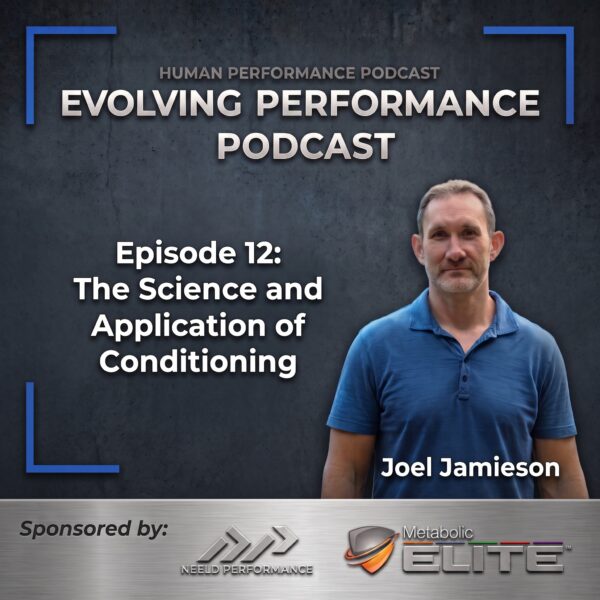
In this episode of the Evolving Performance Podcast, I’m joined by Joel Jamieson, one of the most widely cited authorities on conditioning and energy system development in the world. Joel has trained elite combat sport athletes since 2004 and consulted for organizations from the Navy SEALs to teams in the NFL, NBA, MLS, and NCAA. He is the author of Ultimate MMA Conditioning, created the BioForce HRV system, and developed Morpheus, a training platform that uses daily HRV, sleep, and activity data to individualize heart rate zones.
We start by separating fitness from conditioning — fitness being the measurable physiological qualities, conditioning being how well those qualities integrate to meet a specific demand. Joel explains why heart rate recovery tells you more about repeat sprint ability than VO2 max, how the aerobic system fuels recovery both between reps and across an entire competitive season, and what zone two training actually is beyond the second band on a heart rate monitor. The conversation also covers why the fear that aerobic work makes athletes slower is largely overstated, the real limits of the interference effect, and why fixed heart rate zones misrepresent a body that changes day to day.
This episode offers a clear framework for coaches and athletes looking to build aerobic capacity without sacrificing speed and power, and to understand what actually drives recovery and resilience.
Topics Include:
- Why fitness and conditioning are not the same thing
- Building a performance model to determine what an athlete actually needs
- Why VO2 max poorly predicts repeat sprint performance
- Heart rate recovery as the most underutilized assessment tool
- Reading heart rate recovery between sparring rounds or practice reps
- Resting heart rate vs. HRV — absolute values or direction of change
- The anaerobic speed reserve and how to field test it
- How the aerobic system drives recovery across a competitive season
- What zone two actually is, and why percentage-of-max-HR misses it
- Left ventricular volume vs. contractile strength, and how to train each
- Minimum effective dose for zone two, and why lifting doesn’t count
- Why aerobic training won’t make athletes slower
- Tempo intervals, high intensity continuous training, and uphill sprints
- When the interference effect is real and when it isn’t
- Closing the gap between fitness capacity and game day expression
- Sleep, nutrition, and mental stress as recovery variables
- How Morpheus shifts heart rate zones based on daily recovery
📲 Connect with Joel Jamieson:
Instagram: @coachjoeljamieson
Morpheus: TrainWithMorpheus.com
8 Weeks Out: 8WeeksOut.com
🔥 If you enjoy the episode, please leave a 5-star rating and share it with friends, teammates, colleagues, etc.
Supporting High Performance
Special thanks to this podcast’s sponsor Metabolic Elite. Metabolic Elite’s entire product line is designed to specifically support the health, performance, and recovery of high performers. Each product is formulated using research-supported ingredients and dosages using the highest quality ingredients, so you can be confident that every product you take will deliver the maximal benefit and effect.

Check out why Metabolic Elite’s Liposomal Tablet delivery system is a game-changer: LPT White Paper
Save 15% using the code ‘neeld15’ at checkout here: Metabolic Elite
A few of my personal go-to’s: